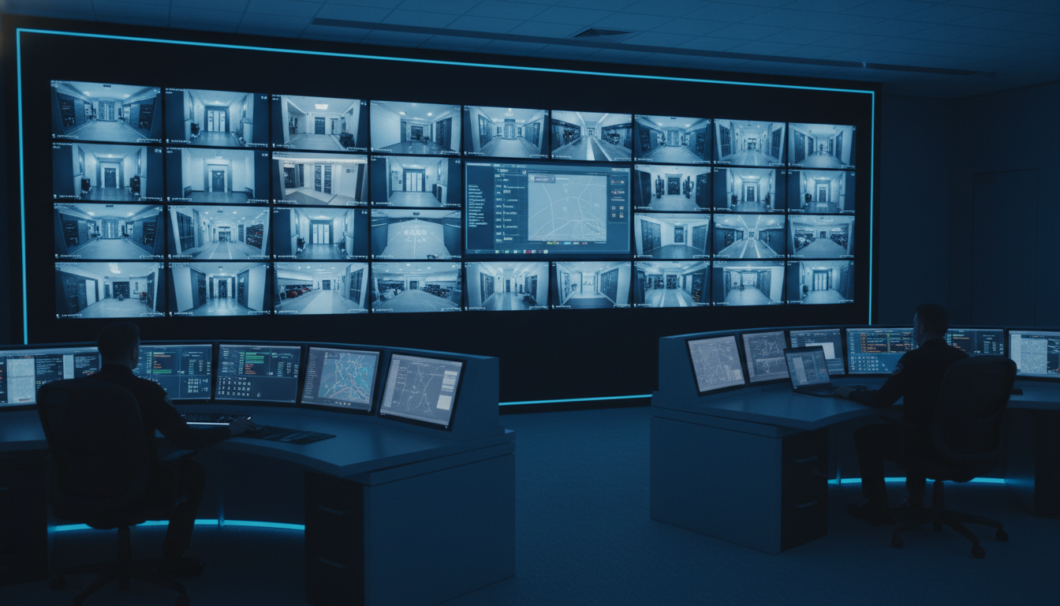

Riverside businesses face rising security risks and growing protection costs. Traditional guards and passive cameras often miss incidents or carry heavy recurring expenses, leaving owners exposed and budgets strained.
Live video monitoring offers a focused, cost-effective solution: high-definition cameras plus trained remote operators who watch feeds in real time. Virtual guards verify threats, issue two-way audio warnings, and trigger verified police dispatch when needed — preventing incidents before they escalate.
Trusted locally by Riverside companies across retail, warehousing, construction, and office parks, live video monitoring delivers enterprise-level security without enterprise-level cost.
Protect Your Riverside Business Today
Speak with our security experts about customized live video monitoring solutions designed specifically for your business needs.
Understanding Live Video Monitoring Systems

Live video monitoring upgrades traditional recording setups by combining intelligent cameras with trained operators who watch live feeds from remote centers. This blend of technology and human judgment reduces false alarms and enables immediate, informed action.
At the core are analytics-enabled cameras that detect activity across designated zones and flag unusual behavior. When a camera detects a trigger, the monitoring center receives an instant alert and reviews the live feed to determine whether intervention is required.
High-definition video captures clear footage day or night, and cloud-based storage preserves evidence securely for later review. A professional monitoring service ties these elements together so your site benefits from continuous oversight without onsite staffing.
Key System Components
- Advanced cameras with motion detection and analytics capabilities
- Remote monitoring centers staffed by trained security professionals
- Two-way audio communication systems for direct intervention
- High-speed internet connectivity for seamless video transmission
- Cloud-based storage for footage retention and evidence collection
- Integration capabilities with existing alarm systems and access controls

How Remote Video Surveillance Works
Simple event flow (typical):
- Camera detects activity in a protected zone using analytics (motion, loitering, object detection).
- System sends an alert and the monitoring team pulls the live feed for verification.
- If verified as suspicious, virtual guards use two-way audio to warn the intruder and, if needed, dispatch verified police with detailed descriptions.
Response times vary by provider and local procedures, but monitoring centers typically review alerts within seconds to a minute. For a technical compatibility check of your existing cameras and networks, contact our monitoring service for a no-cost assessment.

Significant Cost Savings Compared to Traditional Security Guards

Hiring traditional security guards is a major recurring expense for Riverside businesses. An eight-hour guard shift commonly runs in the low hundreds of dollars, and staffing around-the-clock protection quickly pushes annual costs into five figures for small sites and well over $100,000 for larger operations.
By contrast, remote video monitoring delivers comparable protection at a fraction of that price. Monthly monitoring fees typically fall in a broad range depending on coverage needs and system complexity; many businesses see total monthly costs that are much lower than the equivalent onsite guard payroll. That reduced labor burden plus lower benefits and overhead often produces substantial savings.
Typical Cost Factors to Compare
- Traditional guards: wages, overtime, benefits, workers’ comp, training, uniforms, supervision, and scheduling overhead.
- Live video monitoring: one-time installation, monthly monitoring service, cloud storage, and occasional maintenance — scalable across multiple sites.
Direct Labor Expenses
- Hourly wages and overtime for multiple shifts
- Supervisors and scheduling costs
- Replacement staffing for absences and holidays
Indirect Operational Costs
- Workers’ compensation and liability insurance
- Employee benefits and paid time off
- Recruiting, background checks and ongoing training

Remote video monitoring and video monitoring services eliminate most labor-related costs and allow one monitoring service to cover multiple sites. The technology scales without the linear cost increases of guards, producing faster return on investment for many businesses.
Simple ROI Example
- Example mid-size site: replacing two full-time guards (~$100,000/year total cost) with remote monitoring (~$18,000–$26,000 first year including installation) can yield annual savings of tens of thousands of dollars.
Actual savings depend on your property size, risk profile, and chosen package. For an accurate comparison, request a free ROI estimate tailored to your location and needs.
Twenty-Four Hour Coverage Without Gaps or Limitations

Human guards are essential but limited: fatigue, shift changes, and unavoidable breaks create predictable coverage gaps. Guards also can’t watch multiple sites at once, which leaves larger properties vulnerable.
Remote monitoring systems maintain constant vigilance. Modern cameras stream live video to centralized operations, where trained operators monitor multiple sites simultaneously. With redundant power and cellular backups, remote monitoring minimizes downtime from connectivity or power issues.
Strategic camera placement and advanced optics extend visibility beyond what a single guard can cover. Pan-tilt-zoom lenses, wide-angle models, and purpose-built night sensors reduce blind spots and increase situational awareness across your property.
Comprehensive Property Protection
Large properties require layered coverage. Cameras placed across critical zones let monitoring teams see every important area at once — from docks to parking lots to storage yards — and respond immediately when detection rules trigger alerts.

Perimeter Security
Place cameras along fence lines, gates, and loading areas to detect unauthorized access before intruders reach buildings. Virtual guards can warn trespassers via two-way audio and escalate verified incidents to police.
Asset Protection
Cover high-value equipment and storage zones with dedicated cameras and focused detection rules. Motion and object alerts in restricted areas trigger immediate review and intervention.
Access Point Monitoring
Monitor doors, gates and entry lanes continuously. Log and visually verify after-hours access events to support audits and investigations.
Nighttime is when traditional coverage often weakens. Modern cameras use infrared and low-light sensors to capture usable footage in darkness. Combined with audio intervention and rapid remote response, night monitoring closes the vulnerability gap effectively.

Quick Camera Placement Checklist
- Cover all exterior entry/exit points (doors, gates, loading docks).
- Position cameras to protect high-value assets and equipment.
- Mount overlapping views to eliminate blind spots around perimeters.
- Install dedicated night/low-light cameras for dark areas and lots.
- Ensure UPS and cellular backup for continuous remote monitoring.
Immediate Threat Detection and Response Capabilities
Fast response is the difference between a minor incident and a major loss. Traditional alarms alert after a breach; by then intruders may have left with assets or caused damage.
Live video monitoring changes that timeline. Virtual guards watch live feeds and can intervene the moment suspicious behavior appears—using two-way audio to warn intruders and escalating verified incidents to authorities when needed.
Audio intervention is a proven deterrent: many would-be offenders flee when challenged by a live voice rather than risk immediate police contact.

Verified Alarm Response
False alarms strain police resources and can lead to fines or lower priority responses. Live monitoring reduces false dispatches by verifying incidents with video before contacting law enforcement.
When a verified event occurs, monitoring staff supply officers with actionable details — suspect descriptions, vehicle information, and live updates — improving the likelihood of a timely and effective police response.
Traditional Alarm Response Process
- Sensor trips or alarm activates
- Monitoring center receives generic alarm signal
- Center attempts to contact the owner
- If contact fails, a standard alarm call goes to police
- Police respond based on priority and availability
- Often the alarm proves false upon arrival
Live Video Monitoring Response Process
- Cameras detect unusual activity in a monitored zone
- Virtual guards pull the live feed for immediate review
- Guards issue an audio warning to visible suspects
- If confirmed, guards request verified police dispatch with details
- Police receive prioritized information and real-time updates
- Officers are more likely to intercept suspects who remain on the property

Coordinated verification and dispatch create a strong deterrent effect. Criminals learn to avoid properties with active monitoring, and neighborhoods see fewer repeat incidents at monitored sites.
Experience Rapid Response Protection
Our Riverside-based monitoring experts provide instant threat assessment and verified police dispatch. Learn how verified alarm dispatch works or call to discuss response capabilities for your site.
Proven Crime Deterrence and Prevention Results

Visible, active monitoring deters opportunistic criminals more effectively than passive systems. Multiple studies and customer reports show fewer break-in attempts at properties with clearly posted live video monitoring and real-time intervention.
Signage that notes live monitoring and rapid police contact increases that deterrent effect: potential intruders choose easier targets without active oversight. The benefits extend inside the site as well—employee theft and internal shrinkage often drop when staff know monitoring is in place.
Many clients report measurable reductions in incidents after installing live monitoring, though results vary by location and baseline risk. If you’d like, we can share anonymized case examples from local Riverside sites during your consultation.
Measurable Security Improvements
While specific percentages differ by study, vendor and client data commonly show meaningful declines in property crime, vandalism, and trespassing within the first year of active monitoring implementation. Video monitoring also raises accountability across daily operations—deliveries, visitor behavior, and employee procedures improve when activity is recorded and reviewed.


Theft Prevention
Live monitoring prompts many would-be thieves to abandon attempts when challenged by virtual guards. Cameras plus two-way audio reduce losses and improve recovery odds when incidents do occur.

Vandalism Reduction
Vandalism and graffiti incidents decline when perpetrators know they face immediate detection and audio warnings. The result: lower cleanup and repair costs and less business interruption.

Trespassing Control
Persistent loitering and unauthorized encampments decrease when remote guards actively manage perimeters. Audio challenges and verified police notifications restore secure boundaries without continuous physical patrols.
Insurance underwriters often recognize the reduced risk of professionally monitored sites. Many carriers offer premium credits or more favorable terms for properties with verified remote monitoring—check with your insurer for specific qualifications.
Note on privacy and compliance: businesses should post appropriate signage and inform employees about monitoring to comply with local and state laws. We include compliance guidance as part of our site assessments.
Advanced Technology Features That Enhance Protection
Modern video monitoring combines smart cameras, AI analytics, and secure cloud storage to deliver protection that traditional approaches can’t match. These systems reduce false alerts, surface real threats, and give monitoring teams clear, actionable footage.
Advanced analytics learn normal activity at your site and flag deviations for human review. That means the monitoring center sees fewer nuisance alerts and more genuine events — improving response efficiency and lowering operational costs.

Smart Detection Capabilities
Modern detection goes beyond simple motion: systems can distinguish people from vehicles and animals, detect loitering, and flag abandoned objects. That precision focuses monitoring staff on real threats.
- Facial recognition or matching to watchlists (use subject to local law and privacy policy)
- License plate recognition for vehicle tracking and access control
- Object and weapon detection to highlight dangerous items
- Perimeter breach alerts for fence and boundary crossings
- Crowd detection for large gatherings or unusual congregation
- Abandoned object alerts for potential threats

High-Definition Video Quality
Clear footage matters. We recommend a minimum of 1080p for identification areas; 4K is ideal for high-value zones. Low-light sensors and IR ensure usable video at night, while weather-rated housings protect equipment in outdoor conditions.

Cloud storage secures footage offsite and supports easy retrieval for investigations. Look for providers with strong encryption, access controls, and compliance certifications to ensure footage integrity and chain-of-custody when evidence is needed.
Integration With Existing Systems
Video monitoring integrates with alarm panels, access control, and building systems to create a unified security ecosystem. When alarms trigger, monitoring staff pull the relevant video feed immediately — reducing false dispatches and providing police with verified incident details.
Note on privacy and compliance: certain features (facial recognition, license-plate tracking) are subject to legal and policy limits. We include signage and employee-notice guidance with every deployment to help you meet California and local requirements.

Industry-Specific Applications Across Riverside
Live video monitoring adapts to diverse Riverside business environments. Each industry faces specific threats—remote monitoring systems and virtual guards deliver targeted protection that reduces risk and operating cost.

Retail and Commercial Properties
- Primary threats: shoplifting, employee theft, after-hours break-ins.
- Monitoring benefits: live security camera coverage of cash areas, entrances, and sales floors; virtual guards deter incidents with two-way audio.
- Result: lower shrinkage and safer parking lots for customers.

Warehouses and Distribution Centers
- Primary threats: high-value inventory theft, organized cargo theft.
- Monitoring benefits: perimeter and dock coverage, license-plate capture, and event logging across large sites that guards can’t watch continuously.
- Result: fewer losses, improved loading compliance, and safer operations.

Construction Sites
- Primary threats: equipment theft, copper/metal theft, after-hours trespass.
- Monitoring benefits: mobile remote video units and temporary cameras that deploy quickly and move as the project progresses; virtual guards provide audio warnings and verified dispatch.
- Result: reduced material loss and fewer project delays.

Auto Dealerships
- Primary threats: open-lot vehicle theft, vandalism, unauthorized test drives.
- Monitoring benefits: wide-area lot coverage, license-plate capture, and immediate audio challenges to suspicious activity.
- Result: better inventory protection and fewer key-related losses (note: secure key management remains essential).

Office Buildings and Business Parks
- Primary threats: unauthorized access, vehicle break-ins, equipment theft.
- Monitoring benefits: discrete cameras that protect lobbies, parking structures, and entry points without an imposing guard presence; remote verification for after-hours access events.
- Result: professional security that preserves a welcoming environment while preventing data and asset loss.

Why Riverside Businesses Choose Live Video Monitoring
Riverside’s location and commercial mix create distinct security needs. High-traffic transportation corridors and clustered industrial zones attract both legitimate commerce and opportunistic crime, so businesses require reliable, cost-effective protection tailored to local risks.
Remote video monitoring addresses those needs by combining advanced cameras with trained local operators who understand Riverside geography and common threat patterns. That local knowledge helps monitoring teams vet incidents quickly and coordinate verified police response when necessary.

Local Crime Patterns and Business Vulnerability
Industrial parks and warehouses near major highways face elevated theft and organized cargo theft due to quick escape routes. Retail corridors and downtown areas contend with shoplifting and vandalism, while office parks see vehicle break-ins and after-hours access attempts.
Live monitoring targets these vulnerabilities with zone-based detection and real-time verification. Virtual guards can challenge suspicious activity immediately and provide police with verified, actionable information—improving response outcomes compared with generic alarm calls.
Economic Benefits for Riverside Employers
Rising labor costs in Southern California make full-time guard coverage increasingly expensive for small and mid-size businesses. Remote monitoring delivers enterprise-level protection at affordable monthly rates, freeing security budgets for growth initiatives such as hiring, equipment, or facility upgrades.
Many Riverside clients reallocate savings from security payroll to business improvements while maintaining or improving protection levels through centralized monitoring services.

Climate Advantages for Security Technology
Riverside’s dry, temperate climate is well-suited for outdoor security gear—less corrosion and fewer weather-related failures mean lower maintenance and longer equipment life. Clear daytime conditions aid visual monitoring, while modern low-light cameras and infrared sensors handle night coverage reliably.
Affordable Guard Services: Your Riverside Security Partner
Choosing a local monitoring partner ensures faster installations, quicker service calls, and stronger coordination with Riverside law enforcement. Local expertise matters for tailoring detection zones, response protocols, and camera placement to neighborhood conditions.

We have served Riverside commercial properties for over fifteen years. Our local monitoring center operates 24/7 with trained security professionals and virtual guards who know the area — enabling faster, more contextual responses for verified incidents.
Our Comprehensive Monitoring Services
We deliver tailored live video monitoring solutions: strategic camera design, certified installation, continuous monitoring, two-way audio intervention, verified police dispatch, cloud footage storage, mobile access, and ongoing maintenance.
Service Features
- Professional site security assessment and camera placement design
- High-definition camera installation by certified technicians
- Twenty-four-hour monitoring center staffed by trained security experts
- Immediate audio intervention capabilities with two-way communication
- Verified police dispatch with detailed suspect descriptions
- Cloud-based footage storage with extended retention periods
- Mobile app access for remote viewing and system management
- Regular system maintenance and technical support included
Why Choose Our Team
- Fifteen years protecting Riverside commercial properties successfully
- Local monitoring center with established relationships in the area
- Bilingual security staff for diverse client communication needs
- Rapid emergency response procedures and verified dispatch workflows
- Competitive pricing without long-term contracts or hidden fees
- Licensed, bonded, and fully insured security provider
- Proven track record reducing client security incidents
- Personalized service with dedicated account management

Our Riverside Location
Our operations center is based in Riverside for rapid local support. Proximity means faster installations, immediate service calls, and hands-on attention to your security needs.
Visit our Riverside office at 9901 Indiana Ave, Riverside CA 92803 or call us for an immediate security consultation
Partner With Riverside’s Trusted Security Experts
Schedule your free property security assessment today. Our team will design a customized live video monitoring solution that fits your budget and protection requirements.
Simple Implementation Process for Your Business
Moving to live video monitoring is straightforward and designed to minimize disruption. Our streamlined process gets systems live quickly while keeping your team focused on operations. Typical timelines vary by site but most small–mid installations finish within 1–3 days; larger sites are planned with a clear phased schedule.

What to Expect: Step-by-Step Deployment
- Initial consultation & site assessment (1–2 hours) — Our security experts visit to map vulnerabilities, confirm priorities, and review existing cameras and network capacity. We deliver a compatibility check so you know whether upgrades are required.
- Custom system design & proposal (3–5 business days) — We produce a clear plan showing camera locations, detection zones, equipment list, and transparent pricing. You approve the scope before any work begins.
- Professional installation (1–3 days typical) — Certified technicians install cameras, wiring or wireless links, and any required network equipment. We schedule work to minimize business impact and use weather-rated commercial components.
- Testing, configuration & staff training (same day as install) — We test feeds, configure analytics and alert thresholds, and train staff on mobile access and emergency procedures. We confirm monitoring center connectivity before activation.
- Activation & ongoing support — Live monitoring begins when you’re satisfied. We provide 24/7 technical support, scheduled maintenance, and periodic optimization based on real-world event data.

We continually refine detection zones, camera angles, and alert rules after installation to reduce false alarms and improve coverage. Your feedback drives these optimizations so the system adapts to real operational patterns.
Minimal Business Disruption
Camera installs are low-impact: technicians work around your schedule, and many businesses operate normally during deployment. Wireless camera options reduce wiring needs; when network upgrades are necessary we document requirements up front.
Data security and compliance are core to our process. We use encrypted video transmission, role-based access controls, and detailed audit logs. These measures protect footage integrity and help meet IT and legal requirements.

Professional Monitoring Center Operations
Our monitoring center is the operational core for remote video services. It runs on redundant systems—backup power, multiple ISP links, and duplicate hardware—so your live security camera feeds remain available even during local outages.

Trained Security Professionals
Our virtual guards undergo rigorous training in video analysis, threat assessment, law enforcement communication, and de-escalation. Each operator handles a limited number of feeds to ensure focused attention and fast detection.
Monitoring Staff Qualifications
- Comprehensive background checks and security clearances
- Professional security training and certification programs
- Emergency response and crisis management expertise
- Law enforcement communication protocol training
- Customer service and conflict de-escalation skills
- Regular performance evaluations and skills assessments

Response Protocols and Procedures
Our SOPs define tiered responses: minor anomalies are logged and monitored; suspicious actions trigger audio warnings and closer observation; confirmed criminal activity prompts verified police dispatch with descriptive details and timestamps.

These verified reports earn credibility with responding officers and increase the likelihood of effective intervention. We maintain documented communication protocols to preserve chain-of-custody for footage used in investigations.
Integration With Modern Business Systems
Live video monitoring complements your existing infrastructure—access control, alarm panels, and building automation—creating a unified security ecosystem that provides better situational awareness and fewer false dispatches.

Access Control Coordination
Card readers and biometric systems generate entry logs; video monitoring visually verifies those events. When access occurs outside normal hours, monitoring staff compare images to authorized personnel lists and escalate suspicious entries.
Alarm System Enhancement
Video provides eyes on alarm events. When an alarm triggers, guards immediately review associated camera feeds to verify the cause—reducing false police calls and supplying officers with actionable intelligence when dispatch is necessary.

Mobile Access and Remote Management
Owners and managers can view live video and recorded footage via secure mobile apps. Remote configuration lets you tweak detection sensitivity, recording schedules, and user permissions without a site visit.

For more on how advanced video monitoring technology integrates with your systems, visit our detailed overview or request a technical compatibility review during your free assessment.
Detailed Cost Comparison and ROI Analysis
True security cost goes beyond hourly wages. When you compare traditional guard programs to remote video monitoring, include hidden operational expenses—benefits, training, insurance, uniforms, management—and the savings become clear.

Sample Five-Year Cost Projection (Example)
Table below is a representative mid-size site example to illustrate typical savings. Your actual costs will vary by location, staffing, and system choices—request a custom ROI estimate for precise numbers.
| Expense Category | Traditional Guards (Annual) | Live Video Monitoring (Annual) | Annual Savings |
| Labor Costs | $120,000 | $18,000 | $102,000 |
| Benefits and Insurance | $36,000 | $0 | $36,000 |
| Equipment and Uniforms | $4,800 | $0 | $4,800 |
| Training and Certification | $3,200 | $0 | $3,200 |
| Management Overhead | $12,000 | $0 | $12,000 |
| System Installation | $0 | $8,000 (Year 1 only) | -$8,000 |
| Total Annual Cost | $176,000 | $26,000 (Year 1) / $18,000 (Years 2-5) | $150,000 (Year 1) / $158,000 (Years 2-5) |
Using this sample, five-year cumulative savings can exceed several hundred thousand dollars for a typical mid-size commercial property. Savings can be reinvested in operations, staffing, or capital improvements.
Return on Investment Timeline
Many customers recover equipment and installation costs within months, not years. A simple ROI approach:
- 1) Calculate current annual security spend (guards, benefits, overhead).
- 2) Subtract estimated annual monitoring cost (include first-year install).
- 3) The difference is annual savings; installation payback = installation cost ÷ monthly savings.

Insurance premium reductions can add to long-term value—many carriers offer credits or lower rates for professionally monitored properties (varies by insurer and policy conditions).
Reduced Loss Prevention Savings
Preventing a single major theft, vandalism event, or equipment loss can often equal or exceed a year’s monitoring cost. Live monitoring also reduces indirect expenses like business interruption, insurance deductibles, and reputational damage.
Direct Loss Prevention
- Inventory and equipment theft prevention
- Vandalism and property damage avoidance
- Reduced shoplifting and internal theft
- Prevention of copper wire and metal theft
- Vehicle and tool theft deterrence
Indirect Cost Avoidance
- Less business interruption during repairs
- Lower insurance deductible exposure from fewer claims
- Maintained employee productivity without security disruptions
- Preserved customer confidence after incidents
- Reduced legal exposure from inadequate security
Live Monitoring Versus Recorded Camera Systems
Passive, recorded-only camera systems document incidents but do not prevent them. Live monitoring turns cameras into an active service: real-time review, audio intervention, and verified police dispatch when needed.

Passive Recording Limitations
Recorded-only systems require someone to review footage after an incident occurs. Without active monitoring, perpetrators often escape before footage is reviewed. Image quality and camera placement also limit evidentiary value.

Active Monitoring Advantages
Live monitoring prevents crimes through immediate human review and intervention. Virtual guards assess live video, challenge suspicious individuals with audio, and escalate verified incidents to police—creating a strong deterrent effect that passive systems lack.
Passive Recording Systems
- Document crimes after they occur
- Require manual footage review
- Provide evidence but no prevention
- Cannot alert authorities in real time
- Limited deterrent effect
- Miss incidents without active monitoring
Active Live Monitoring
- Prevent crimes through immediate intervention
- Continuous professional observation without gaps
- Real-time threat assessment and response
- Verified police dispatch during active crimes
- Strong deterrent effect on potential criminals
- Improved incident documentation and follow-up
Combining continuous recording with professional live monitoring delivers the best of both approaches: prevention, verified dispatch, and reliable footage for investigations and insurance claims.
Emerging Technologies in Video Monitoring Services
Security technology is evolving quickly. New tools — from AI analytics to drones and predictive models — improve threat detection, reduce false alerts, and lower long-term monitoring costs. Early adopters often gain stronger protection and better ROI.

Artificial Intelligence Integration
Machine learning analyzes live video feeds to spot patterns humans can miss. AI flags unusual behavior, reduces nuisance alerts, and helps monitoring staff focus on real threats. Common AI features include object and activity recognition, loitering detection, and abnormal-route alerts.
Some systems offer facial matching and license-plate recognition. Note: these capabilities are subject to legal and policy limits — we advise clients on compliant use and proper signage when features are enabled.
Object recognition can identify potential tools of theft (bolt cutters, crowbars) or weapons, triggering faster human review and intervention. Many innovative monitoring platforms integrate these AI capabilities for enhanced threat detection.

Drone Integration
For large sites, drones provide mobile eyes when ground cameras detect activity beyond fixed coverage. Automated deployments can give an aerial perspective to assess threats and track movement across property. Drone use follows FAA and local rules; we work with clients to ensure compliant, effective deployments.
Predictive Analytics
Historical incident data and environmental inputs (time of day, weather) let systems predict higher-risk periods. Monitoring resources and detection sensitivity can be scheduled dynamically, increasing vigilance when incidents are statistically more likely.
Weather-aware monitoring adjusts parameters for storms, fog, or extreme conditions to maintain effective detection and reduce false positives.

Frequently Asked Questions About Live Video Monitoring
How quickly do virtual guards respond to detected threats?
Response times vary by provider and event type; typical monitoring centers review alerts within seconds to one minute. Audio warnings can deploy immediately while verified police dispatches follow local procedures.
What happens if internet connectivity fails at my property?
Modern systems use redundant links (primary internet plus cellular backup). Cameras also record locally during outages and upload footage when connectivity returns, minimizing gaps in coverage.
Can monitoring services integrate with my existing security cameras?
Many IP cameras integrate with professional monitoring platforms. We evaluate compatibility during the initial assessment and recommend upgrades only if necessary to meet performance or analytics requirements.
How many cameras does my business location actually need?
Needs depend on property layout and vulnerability points. Small retail stores often use 4–8 cameras; large warehouses may need 20+. Our site assessment will recommend optimal quantities and positions to avoid unnecessary equipment costs.
What video resolution quality should I expect from monitoring cameras?
Professional monitoring typically uses at least 1080p resolution; critical areas benefit from 4K. Higher resolution improves identification when zooming and aids investigations.
How long does video footage remain stored and accessible?
Standard cloud retention ranges from 30 to 90 days depending on package. Critical incidents can be archived indefinitely. Custom retention plans support regulatory or insurance needs.
Will monitoring services work during power outages at my facility?
Systems include battery backup (UPS) for network devices and optional camera battery packs providing several hours of operation. Monitoring centers also receive outage alerts so staff can adapt response procedures.
How do monitoring centers handle multiple simultaneous alerts?
Professional centers staff to handle expected volumes and use prioritization rules so the most serious events are reviewed first. Staffing scales for high-activity periods to prevent overload.
Can I access my security cameras remotely through mobile devices?
Yes — secure mobile apps provide live viewing, push notifications, and recorded footage access on iOS and Android. Owner permissions and audit logs control who can view and download footage.
What maintenance requirements exist for video monitoring equipment?
Cameras require minimal upkeep. We recommend quarterly inspections, software updates, and occasional lens cleaning. Service agreements typically include routine maintenance and fast technical support.
Begin Protecting Your Riverside Business Today

Don’t leave your business exposed. Start with a free, no-obligation security assessment and get a clear plan that fits your budget and risk profile. We offer phone, email, or a 15-minute virtual consult to get started quickly.
Next Steps Toward Complete Protection
Contact our Riverside team to schedule your property evaluation (typically 30–60 minutes). You’ll receive a tailored proposal with camera placements, system specs, and transparent pricing. Installation often begins within a week of approval, depending on scope.

Schedule Your Free Security Assessment
Take the first step toward comprehensive business protection. Our Riverside security experts are ready to design your customized live video monitoring solution. No obligation—choose phone, email, or a short virtual consult to begin.
Conclusion: The Clear Choice for Riverside Business Security

Live video monitoring brings together advanced technology, trained monitoring staff, and verified response to deliver stronger security at lower ongoing cost than many traditional models. For Riverside businesses, it’s a practical way to protect assets, deter criminals, and gain operational peace of mind.
If you’re ready to explore remote video monitoring for your site, contact our local team for a free assessment and custom ROI estimate. Modern monitoring makes enterprise-grade protection accessible to businesses of all sizes.